
Are “Zentangle Patterns” Copyrighted?
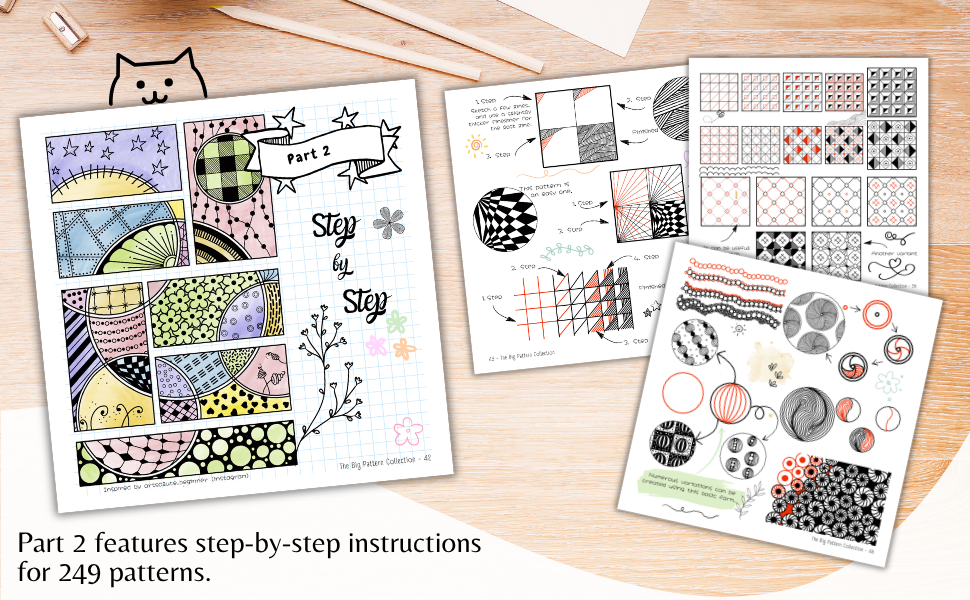
I’m often asked whether so-called “Zentangle patterns” are copyrighted, why the patterns in my books don’t have names, and whether readers are free to use them in their own artwork.
The short answer is: yes, you can absolutely use them.
To be honest, this topic can become surprisingly emotional. Even within the Zentangle® community, there are sometimes lively debates about who “invented” a particular pattern, who named it first, and whether the original source should always be credited.
I once saw someone present a pattern as her own creation and give it a beautiful new name. The only problem was that many of us had already been drawing exactly the same motif in the margins of our school notebooks back in the 1980s. 😊
And that is really the heart of the matter.
Most so-called “Zentangle patterns” are based on lines and shapes that have existed for a very long time. They are often inspired by tiles, fabrics, wallpaper, lace, architectural details, and decorative art from cultures all over the world.
In fact, I once watched a Zentangle® member explain how he spotted a plastic tablecloth in a shop window, took a photo, and later turned that design into a new pattern with its own name.
Which raises an interesting question: if we insist that every pattern must be credited to the person who first shared it, shouldn’t we also credit the manufacturer of the tablecloth? 😊
And if we credit the tablecloth manufacturer, shouldn’t they in turn credit whoever inspired their design?
If we insisted on tracing the source of every pattern, we would quickly find ourselves in an endless chain of inspiration. A pattern might be inspired by a kitchen tile, which was inspired by a textile, which was inspired by Persian ornament, which was inspired by something carved centuries ago.
At some point, it becomes impossible to say where a pattern truly began.
That is exactly why the patterns in my books do not have names.
To me, giving a pattern a name can sometimes create the impression that it was invented by one specific person. And besides, what should I do if one artist in Germany calls a pattern “Sunny Loops,” another artist in China calls the same pattern “Dragon Dance,” and someone else in Texas decides to name it “Bob”? 😊
Should I list all possible names and add a glossary longer than the book itself?
I’d rather keep things simple.
My goal is not to claim ownership of patterns. My goal is to share a hand-drawn library of patterns that you can use freely for doodling, mandalas, Zentangle®-inspired art, journaling, and countless other creative projects.
What matters most is not who named a pattern first. What matters is that drawing helps us relax, sparks our creativity, and brings us joy.
And that part belongs to everyone. ✨
Note: Zentangle® is a registered trademark and refers to a specific drawing method created by Rick Roberts and Maria Thomas.
